
Personalized Physiotherapy Plan Canada: Blueprint Health
- Yasmine Favis
- Jun 26
- 9 min read

Most wellness plans fail because they treat the person as a collection of symptoms rather than a whole individual. Research published through the Canadian Physiotherapy Association confirms that patients who receive individualized treatment protocols recover significantly faster than those placed on generic programs. If you have been cycling through therapists, stalling in your recovery, or wondering why your injury keeps returning, the problem is almost certainly a lack of a personalized physiotherapy plan tailored to your specific mechanics, lifestyle, and goals. This article breaks down exactly how Blueprint Health builds those plans and why the integrated model outperforms single-discipline care.
Table of Contents
Quick Takeaways
Key Insight
Explanation
Assessment comes before treatment
Blueprint Health conducts a thorough intake evaluation covering movement patterns, injury history, and lifestyle factors before a single treatment is assigned.
Combining physiotherapy with massage therapy accelerates outcomes
Soft tissue work reduces muscle guarding, which lets physiotherapy exercises produce better neuromuscular re-education results in fewer sessions.
Direct billing eliminates a major drop-off point
Patients who have to submit claims manually are statistically more likely to stop treatment before completing their plan. Direct billing keeps attendance high.
MVA coverage is often under-used
Many Canadians involved in motor vehicle accidents do not realize their benefits cover ongoing physiotherapy and massage therapy at no out-of-pocket cost.
Athletes need load-management built into their plan
A wellness plan for a competitive athlete must account for training cycles, not just pain levels, to avoid re-injury during performance phases.
Holistic does not mean unscientific
At Blueprint Health, holistic means addressing the full person using evidence-based techniques, not replacing clinical care with unverified alternative methods.
Consistency of practitioner matters more than clinic size
Seeing the same registered physiotherapist throughout your plan produces better outcomes because the therapist can track subtle changes in your movement quality.
What Is a Personalized Wellness Plan?
A personalized wellness plan is a documented, time-bound treatment roadmap that connects your specific diagnosis, functional goals, and available resources into a single coordinated program. It is not a list of exercises printed from a template. It is a living document that changes as you improve, plateau, or face setbacks.
In practice, the difference between a generic plan and a personalized one shows up within the first two weeks of treatment. Generic programs assign the same rotator cuff protocol to every shoulder patient. A personalized plan considers whether you are a recreational swimmer, a desk worker, or a collision victim, and adjusts the loading strategy, manual therapy frequency, and home exercise volume accordingly.
The holistic approach at Blueprint Health adds another layer. Practitioners look at sleep quality, stress load, nutrition patterns, and occupation as context for why an injury is not healing at the expected rate. These are not soft variables. They are documented contributors to inflammation, tissue repair speed, and neuromuscular inhibition.


Pro tip: When you book your first appointment at Blueprint Health, bring any previous imaging reports, physiotherapy discharge summaries, or insurance documentation. This cuts the intake assessment time in half and ensures your plan starts from a complete clinical picture rather than a blank slate.
The Blueprint Health Assessment Process
The intake assessment is where a personalized physiotherapy plan either succeeds or fails before it even begins. A common mistake in many Canadian clinics is rushing through intake to reach billable treatment time faster. Blueprint Health structures the first session so that assessment occupies a meaningful portion of the appointment.
Movement Screening and Functional Testing
Practitioners use standardized movement screens alongside functional tests relevant to your specific activity demands. A runner gets assessed differently than a hockey player or a sedentary office worker with chronic low back pain. The goal is to identify not just where you hurt, but why you hurt there and what upstream or downstream dysfunctions are contributing.
This includes joint range of motion testing, muscle strength grading, postural analysis, and when relevant, sport-specific movement patterns. The data from this screen becomes the baseline against which all progress is measured.
Goal-Setting That Is Actually Specific
Generic goal-setting produces generic results. Blueprint Health practitioners are trained to convert vague goals like "I want to feel better" into measurable outcomes: return to running 5 kilometers without pain within eight weeks, or achieve 90 percent of pre-injury shoulder flexion strength within six sessions. Specific targets keep both the practitioner and patient accountable.
"Individualized care planning is associated with higher patient satisfaction, better adherence to rehabilitation protocols, and improved functional outcomes compared to standardized group interventions." - Canadian Physiotherapy Association position on patient-centred care
How Physical Therapy and Massage Therapy Work Together
Separating physiotherapy from massage therapy is one of the most persistent structural errors in Canadian clinic design. The two disciplines address overlapping tissue systems, and treating them as independent services creates gaps in your recovery timeline.
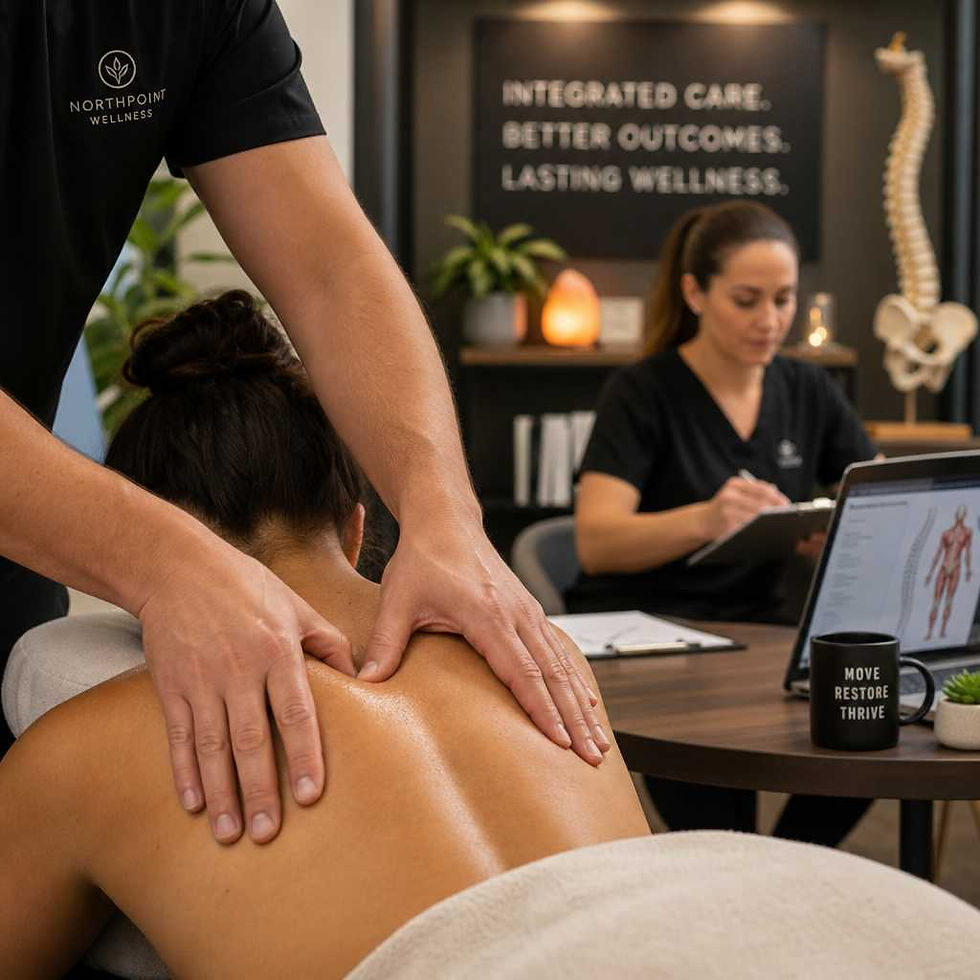
In practice, massage therapy performed before physiotherapy exercises reduces protective muscle guarding. When a muscle is in a chronic state of tension, it cannot produce coordinated movement patterns reliably. Manual soft tissue work breaks that cycle, allowing the therapeutic exercise component of your session to reach the correct target muscles rather than compensating around them.
When Massage Therapy Leads the Session
For patients in acute or sub-acute phases of injury, starting with massage therapy is often the correct sequencing. Pain levels are still elevated, trust in the tissue has not returned, and the nervous system is in a protective state. Massage therapy down-regulates the pain response and creates a window for physiotherapy work that would otherwise be impossible to complete with quality.
When Physiotherapy Leads the Session
For patients in the rehabilitation and performance phases, physiotherapy exercises should come first while the neuromuscular system is fresh. Massage therapy can then be used post-exercise to accelerate tissue recovery and reduce delayed onset muscle soreness. This sequencing is particularly effective for athletes managing high training loads alongside their rehabilitation program.
Pro tip: If your current clinic keeps your physiotherapy and massage therapy appointments completely separate with different practitioners who never communicate, request a care coordination meeting. At Blueprint Health, practitioners work from a shared clinical file so your massage therapist and physiotherapist are always aligned on your current phase of recovery.
Insurance and MVA Coverage: Removing Financial Barriers
Financial friction kills treatment plans. A patient who has to submit paper claims, wait for reimbursement, and manage out-of-pocket costs between payback cycles will start skipping appointments. This is not a willpower problem. It is a structural problem that direct billing solves.
Blueprint Health bills directly to major Canadian insurance providers, which means the transaction happens between the clinic and your insurer without you acting as the intermediary. For athletes on employer benefit plans and injury patients with extended health coverage, this removes the single most common reason people abandon their wellness plan before completion.
Motor Vehicle Accident Benefits: What Most Patients Do Not Know
If you were injured in a motor vehicle accident in Canada, your treatment is typically covered under the at-fault driver's insurance or your own policy through the Statutory Accident Benefits Schedule, depending on your province. Most patients underestimate how much physiotherapy and massage therapy coverage they actually have access to following an MVA.
Blueprint Health has direct experience navigating MVA claims across multiple provinces. The intake team helps patients understand their entitlements from the first appointment, so coverage gaps do not become surprises mid-treatment. This is a meaningful operational difference from clinics that leave patients to figure out their own claims process.
Personalized Plans for Athletes vs. Injury Recovery Patients
Athletes and injury recovery patients share some overlapping needs, but their wellness plans require fundamentally different structures. Treating them the same way is a clinical error that Blueprint Health specifically avoids.
The Athlete Model: Performance and Prevention Together
For athletes, a personalized physiotherapy plan must account for their current competitive schedule. A recreational marathon runner four weeks out from a race needs a different loading strategy than the same runner in an off-season block. The plan has to manage training volume, tissue adaptation, and performance maintenance simultaneously.
Blueprint Health practitioners who work with athletes understand periodization concepts well enough to align rehabilitation timelines with training calendars. This is not standard physiotherapy training. It requires exposure to sports science principles that most general practice clinics do not incorporate.
The Injury Recovery Model: Systematic Progression
For patients recovering from injuries, whether from a workplace incident, MVA, or gradual onset, the plan is built around tissue healing timelines and functional milestone gates. Progression is earned by meeting clinical criteria, not by calendar time alone. A patient whose shoulder is still in the inflammatory phase does not move into strengthening exercises just because two weeks have passed.
The data consistently shows that graded exposure to load, combined with patient education about pain science, produces better long-term outcomes than passive treatment-heavy plans. Blueprint Health's model reflects this evidence by building active rehabilitation components into every plan from the earliest appropriate phase.
Comparison of Wellness Plan Approaches
Not all clinic models are built the same. Understanding the structural differences helps you make an informed decision about where to invest your time and health benefits.
Feature
Blueprint Health Holistic Model
Single-Discipline Clinic
Large Franchise Physio Network
Assessment depth at intake
Comprehensive: movement, lifestyle, goals, history
Limited to the presenting complaint
Standardized intake form, variable practitioner follow-through
Treatment integration
Physiotherapy and massage therapy coordinated from a shared file
One modality only, no cross-referral
Multiple modalities but often siloed by department
Direct billing
Yes, to major Canadian insurers and MVA coverage
Varies, often manual claims only
Usually yes, but coverage expertise varies by location
Plan personalization
Built around individual goals, sport, and lifestyle
Template-based with minor modifications
Template-based with brand-standardized protocols
Practitioner continuity
Same registered therapist throughout the plan
Usually consistent but depends on scheduling
High staff turnover common at franchise locations
The franchise model offered by competitors in the Canadian market typically prioritizes scalability over personalization. That trade-off works for high-volume, low-complexity cases. It does not work for athletes managing performance alongside rehabilitation, or MVA patients with multi-system injuries requiring coordinated care across disciplines.
Frequently Asked Questions
How long does it take to build a personalized physiotherapy plan at Blueprint Health?
The initial assessment and plan development happen within your first appointment. Your registered physiotherapist will review your intake information, conduct the in-person movement assessment, and present a working plan with timelines and expected milestones before you leave. The plan is then refined after your second or third session once the practitioner has observed how your body responds to initial treatment.
Does a personalized wellness plan cost more than a standard physiotherapy appointment?
The per-session cost at Blueprint Health is consistent regardless of whether you are following a highly personalized plan or a more standard protocol. The added value of a personalized plan comes from efficiency: you typically require fewer total sessions because the treatment is targeted correctly from the start. For patients with direct billing coverage, the financial difference is minimal.
Can I get a personalized plan if I was injured in a motor vehicle accident?
Yes. MVA patients are among the most important candidates for a personalized physiotherapy plan because their injuries are often multi-structural and involve both physical and psychological components. Blueprint Health's team has direct experience managing MVA cases across provinces, navigating insurer requirements, and building plans that address the full scope of accident-related injuries including whiplash, soft tissue damage, and chronic pain development.
Do I need a referral from my doctor to start a personalized plan at Blueprint Health?
In most Canadian provinces, you do not need a physician referral to access physiotherapy services. You can book directly with Blueprint Health and the intake process will determine whether additional diagnostic information is recommended. Some insurance plans require a referral to activate extended health benefits, so checking your plan documents before your first appointment is worth the five minutes it takes.
How does Blueprint Health's holistic approach differ from a clinic that only offers physiotherapy?
A single-discipline physiotherapy clinic can address biomechanical dysfunction effectively, but it cannot address the soft tissue component of your recovery with the same depth as an integrated model. Blueprint Health's approach means your massage therapist is working from the same clinical notes as your physiotherapist. When one practitioner notices a change in your tissue quality or pain response, that observation is immediately available to the other. This coordination is what produces faster outcomes for complex or slow-to-heal presentations.
What types of athletes does Blueprint Health work with?
Blueprint Health works with athletes across recreational, competitive amateur, and professional levels. Common presentations include running injuries such as iliotibial band syndrome and plantar fasciitis, shoulder injuries from overhead sports like swimming and volleyball, and collision sport injuries involving the cervical spine and lower extremity. The personalized plan for each athlete accounts for their specific sport demands, current season phase, and return-to-sport timeline.
If you have been through a cookie-cutter rehabilitation program that did not get you where you needed to go, share your experience in the comments below because your feedback helps others make better decisions about their care.


Comments